
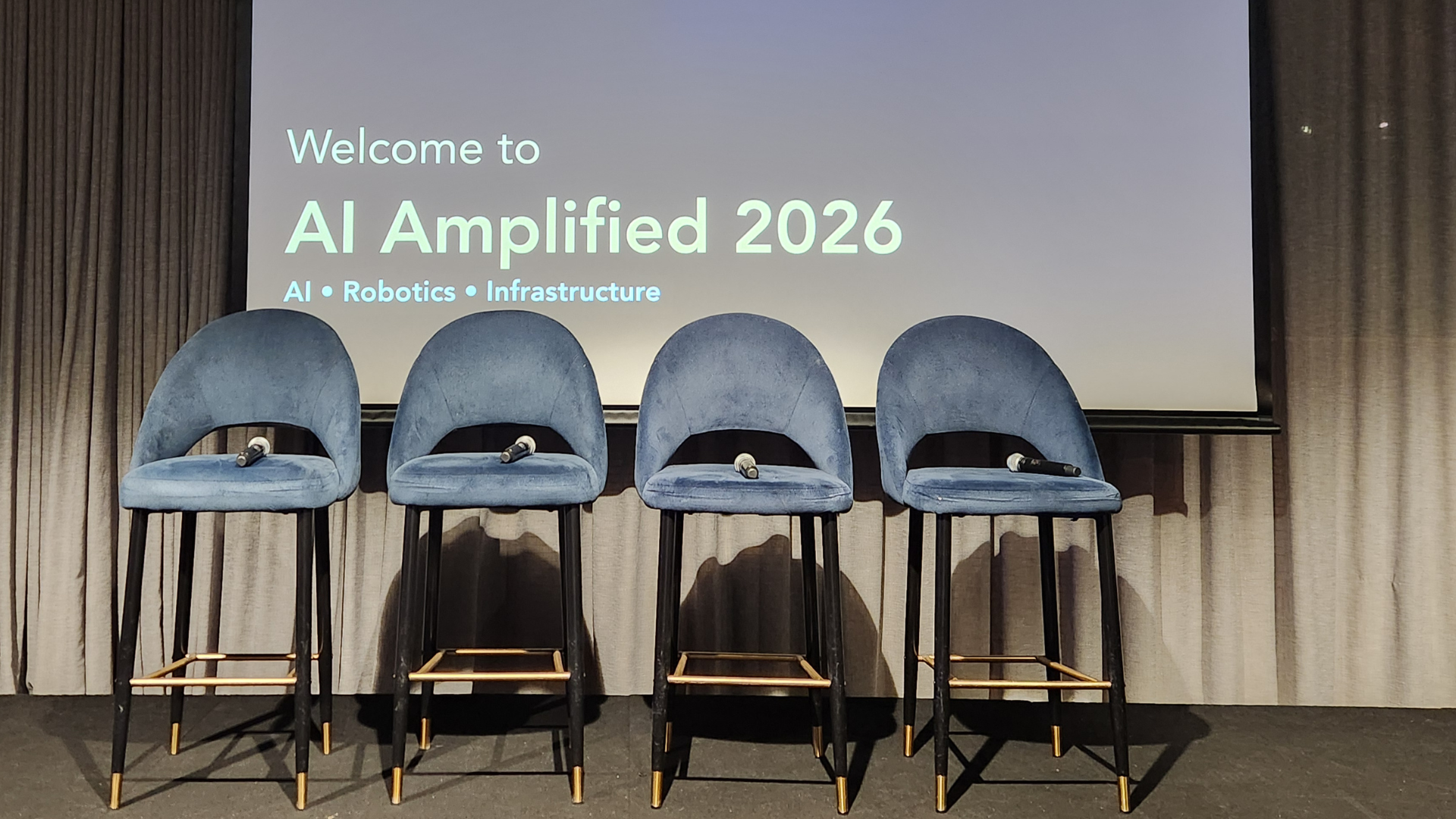
I walked into NVIDIA and Multimedia Technology's AI Amplified 2026 expecting answers on where the future of AI is headed. Leading technologists from the likes of Atlassian, Vertiv, Synology, and more on the same stage, discussing their latest innovations.
I walked out with more questions, more uncertainty. And that's exciting.
Uncertainty means the future of AI is still being written. For the increasingly AI-powered SaaS industry, that comes with both challenge and opportunity.
Here are the six questions I'm taking back to my team.
1) What does your AI infrastructure look like?
From the panel discussion to the product demos, two conversations kept coming up: data sovereignty and the physical limits of data centres.
Globally, we're seeing a shift towards data sovereignty. In Europe, 84% of companies have moved or are moving towards sovereign cloud solutions. With AI regulations and cybersecurity concerns still evolving, control over your data is becoming a necessity, especially when the global average cost of a data breach amounts to $4.99M USD, according to IBM's 2026 report.
Vertiv's Product Manager, Faraz Ali, shared that the shift towards sovereignty and the cost of the cloud are pushing more companies towards on-prem or hybrid models. But the infrastructure and the demand are not always aligned: in places like Australia, for example, there isn't enough electricity to supply the demand for data centres.
Faraz expects racks to run hotter, liquid cooling to become the norm, and data centres to move to DC power over time.
Sovereignty goes beyond where the data is physically stored; that's data residency. It covers ownership, operations, access, and capability. A data centre built in your country but regulated under foreign law isn't fully sovereign. And if your company operates across multiple regions, a tighter focus on sovereignty can make data management harder, not easier.
As a SaaS leader, that's the tension you need to be planning for. Think of it less as a sovereignty question and more as a supply chain question.
Any AI feature you use or build has a supply chain: the model, the host, the data centre, the power source, and the laws that govern each part. It touches every corner of SaaS, from product features to customer data to the company's general ledger.
The question is: Do you know where every link in the chain sits, and what's your plan if one of them changes its price, terms, or access?
2) How are you solving problems with AI?
In SaaS, being best-of-breed is often the end goal. I've seen that hunger in action. Sometimes, it can tempt teams into chasing a frontier AI model of their own.
But as NVIDIA's Senior Developer Relations Manager, Haritha Thilakarathne, reminded us, no single model solves everything. Reaching for the most sophisticated one can be like "killing a fly with a sledgehammer" when a smaller model or hybrid approach would suffice.
When deciding what AI use case to build for your customers, focus less on the mechanics, and more on the problem you are solving. Sometimes an automation offers more return on investment than an agent. But you can't make that call until you know what you're solving for.
With the same problem being attacked by multiple competitors and AI tools, the edge goes to whoever knows the problem best.
ResetData's Head of Sales, Chris Sassone, said plainly: "The SaaS that is going to die is going to be the scrapers." The companies with gated, specialised expertise will survive, and the ones that can harness that expertise to design an innovative solution will pull ahead.
In 2026 and beyond, deeper understanding of your customers won't come from market research alone. It could come from:
- Shared institutional knowledge. Depth isn't developed overnight, but the right system can accelerate it: data that flows between departments, information that shows up in one source of truth, and leaders who are trained to pass on what they know.
- Lived experience. Customers connect with brands that can speak their language, and becoming fluent is easier when you recruit and amplify people who share their lived experience. A seasoned lawyer joins the marketing team at a legal SaaS company. A junior employee with ADHD advises the product team on neuroinclusive design.
- Innovative empathy. Building relationships, forming partnerships, and putting yourself in someone else's shoes help you relate to your customers. But leveraging that empathy to design newer and better answers to your customers' problems is what counts. Are you automating a broken system, or are you reimagining a new and improved one?
Since the rise of AI, security, speed, flexibility, and certainty in your software are less of a selling point and more of an expectation from your customers. And as we see a shift from training to inferencing, from building the AI model to using it in real time, "business value depends on sub-second responses at the point of action," as Faraz put it.
The first lever is depth of understanding. The second is speed of delivery.
The question is: How deeply do you know your customers' problem, and how does that depth show up in the solutions you're building?
3) What are your agentic AI guardrails?
The question is no longer whether agentic AI is capable. It's how can the quality and reliability of those capabilities be ensured?
Based on the conversations at AI Amplified, here's a roadmap for what that can look like:
- Decide who has authority before you build anything. Who is accountable for what the agent does? Your customer might prompt or approve the final action, but your company is also responsible for how your agentic features behave. John McGiffin, CEO of Natural Velocity, suggested the RACI model to define who is Responsible, Accountable, Consulted, and Informed. Which humans should be in the loop, and when?
- Build the security system first. As Haritha said, "don't wait for the ninth step" to create guardrails and fail-safes for your agents. Be closed by default. Give access on a need basis. Lay the right foundation that scales, then add the harness, then build the agent on top of that.
- Plan for errors. With agents working autonomously, you need an alerting system that fires as soon as something could or does go wrong. Pushyami Gali, Head of Engineering at Atlassian, asked three questions that every SaaS company developing an agent should be able to answer: When there's an error, how should we know? How should we block? What can go wrong?
- Manage the data. Depending on the direction AI sovereignty, infrastructure, and regulations end up going, how your agent collects, processes, and interacts with data could have serious implications for your company. Start planning early. For example, Synology's ANZ Country Manager, Jacqueline Graciella, spoke to the importance of data protection, suggesting tactics like the 3-2-1-1-0 backup strategy: 3 copies of your data on 2 different media, 1 offsite, 1 immutable, and 0 errors.
- Keep improving. Pushyami talked about treating her AI like an intern and learning what it needs to succeed. And regardless of the AI itself, I believe that skill of cognitive empathy and curiosity is the key to leading the curve. Your customers' needs, your company's direction, your team's capacity, and the state of AI can change at any moment. The leaders who encourage people to ask questions, raise concerns, and suggest new ideas will be the first to spot the security risk before it becomes a breach.
The responsibility doesn't just land on the product and engineering teams. If you're leading the GTM campaign, you're making promises about what the agent will do. If you're managing finances, you're weighing the potential costs against the potential rewards. If you're using an agent internally, you're deciding how and where to use company data. Security is everyone's responsibility.
The question is: How are you continuously ensuring quality and safety of your AI agents for yourself and your customers?
4) Are your customers getting the most value out of AI?
Apparently, Australians are close to leading the world in ChatGPT and Claude use, but fall short when it comes to building AI capability. Chris Sassone summed it up: "Usage is high and creation is low."
For SaaS companies, gaps like these show up in your customer base. Knowing how to use an AI feature or prompt an agent is one thing. Knowing how to identify, build, and evaluate an AI use case is less common. That's why being able to connect those dots clearly, in a way that matters to your customers, gives you an edge.
A tool can be switched on, and a feature can be shipped at the same time as a competitor, but only a person can build rapport with a customer, understand what they're trying to achieve, and teach them what good AI looks like.
When customers know how to use your AI features well, they can see the return on investment for themselves. And when they are empowered by the connections they have with people at your company, they have an incentive to stay that can't be replicated with another tool.
As a leader, the success of your team starts with you. How you enable them to use AI influences how they enable your customers to do the same.
I predict the SaaS companies that stand out in the sea of AI-native everything won't necessarily have the best build, but will have the best enablers, educators, and relationship-builders on their team.
The question is: How are you training your team to help customers get the most out of AI?
5) Are you in the room where AI is being shaped?
As Multimedia Technology's NVIDIA Business Manager, Carey Hassall, said, "AI is a team sport." And with AI becoming more complex, the right specialists in the same room can find the answers together.
The SaaS industry has already played an important role in placing AI features in the hands of everyday people. But shipping isn't the same as shaping. The questions of where AI should be used, what problems it should be solving, what it should cost to build, and who carries the risk are ones that the SaaS industry can offer an important perspective on—and that's exactly why we need more people in SaaS, especially leaders, to be in these rooms.
Those rooms also need a greater variety of expertise. At AI Amplified, 3 of the 9 speakers I saw were women, and the audience generally skewed male. Just as important, the people with the sharpest insight into where AI could make the biggest difference are often the ones you might not consider inviting: community leaders, environmentalists, social workers, therapists, teachers.
More representation allows for more knowledge, more balance, and more collaboration across sectors—and that's the perfect breeding ground for innovative solutions to problems that matter.
The question is: How are you contributing to the conversation, and who else should we be including?
6) Are we missing the point?
American essayist, Wendell Berry, once wrote when comparing a strip-miner and an ideal farmer: "The standard of the exploiter is efficiency; the standard of the nurturer is care."
One focuses on speed and short-term gain. The other focuses on long-term sustainability and genuine investment, even if that requires extra steps.
And it makes me wonder, are we missing the point when we focus on AI efficiency? Is 10xing your productivity truly the best that AI has to offer?
Productivity and efficiency measure whether a task was completed and how quickly. But it's the quality, impact, and commercial implications of that task that determine whether it counted for something. Sometimes, that takes more time and effort.
That's where I believe proportionality comes in. Are the labour and resources required proportional to the value of the intended outcome?
A routine report that once took hours and now takes minutes with AI is proportional. A pitch deck that AI can generate in minutes but requires extensive revision is disproportional. For a task that requires care, more time and human effort could also be more proportional than an AI tool that can deliver to a similar standard without the care required.
Once you understand the proportionality of the AI use case, you can compare it to the value of a human completing that task. A customer success manager who can relate and laugh with their fellow humans will build stronger relationships and earn greater loyalty than any chatbot could achieve.
So, what if your AI infrastructure requires more resources than you have the capacity to deliver? Or the AI model you're building is more complex than the problem it's solving? Or the level of risk behind an agentic workflow outweighs the level of security you can provide?
Efficiency is a number. Proportionality is an equation. If the numbers don't add up, something needs to be changed or removed. But when they do add up, then that's where your return on investment—and competitive advantage—lies.
The question is: Are the labour and resources involved in your AI use case proportional to the value of the intended outcome, and if not, what needs to change to balance the scales?
Lean in
The uncertainty is the opportunity.
The output of AI is only a fraction of what it can offer. The collective input of human beings is where the real value lives: the chance to break down silos, knowledge-share across sectors, and co-design the future of AI.
As a SaaS leader, you're already part of the AI ecosystem. The challenge now is deciding what role you want to play in it, and how to bring your team into the conversation with you.
